











Four Columns, Falling Notes, and the Pursuit of Perfect
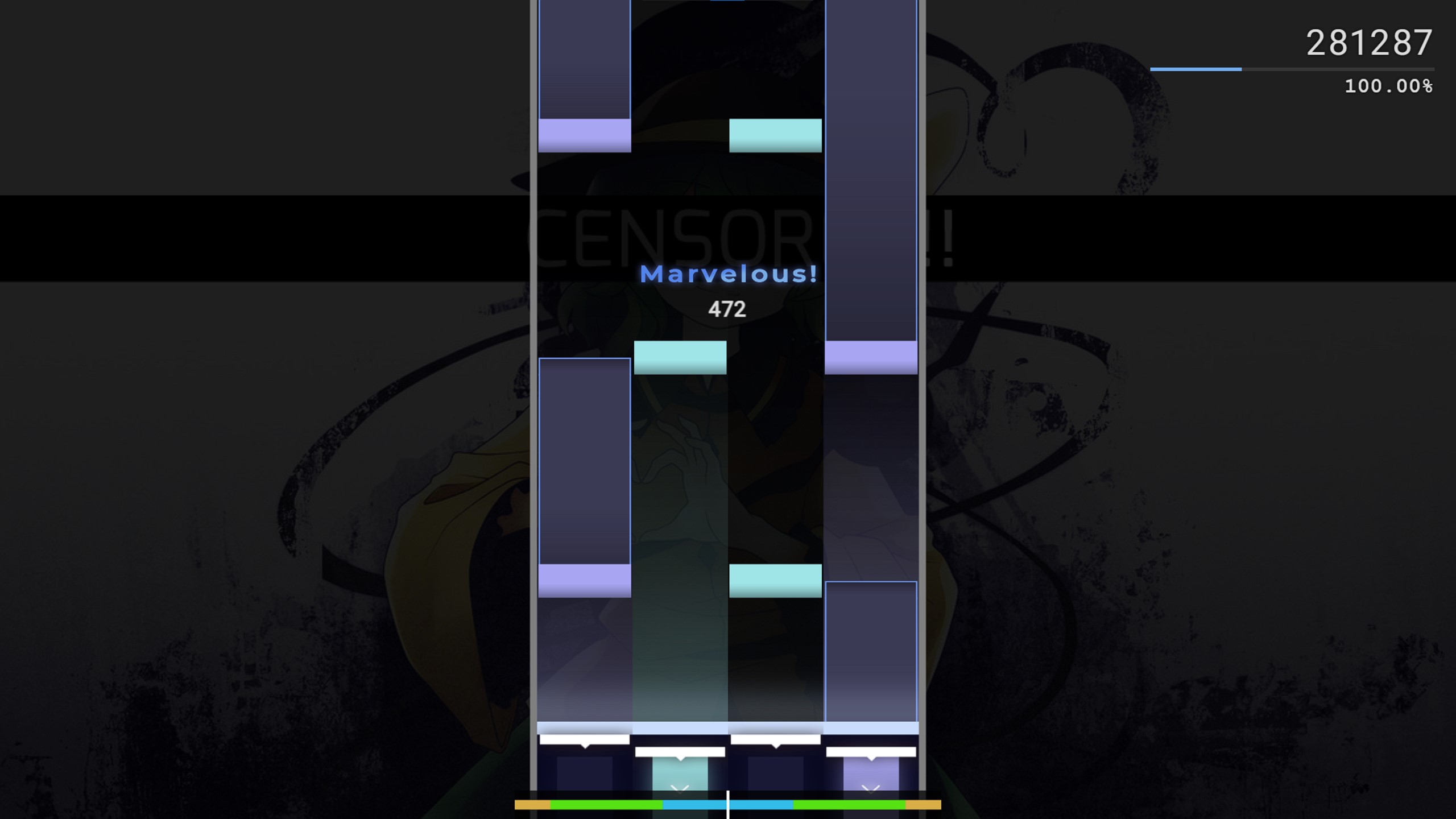
Vertical scrolling rhythm games live and die by the quality of their timing engine, and osu!mania — the mania mode from ppy's osu! platform — is one of the most respected in the genre. Notes descend in columns toward the judgement line; the player presses the corresponding key as each note arrives. The precision of the timing window determines your rating: 300 for perfect, 100 for good, 50 for barely, miss for nothing. Accuracy compounds into score and grade, and the difference between an S-rank run and a B-rank is entirely in the milliseconds. That granularity is what gives osu!mania its competitive depth — there is always a more precise version of the run you just completed.

Thousands of Beatmaps, Every Genre, Every Difficulty
The community-created beatmap library is osu!mania's single greatest asset. Thousands of charts exist across every musical genre and difficulty tier, from beginner patterns with gentle four-note streams to expert-level density maps that test both reading speed and physical stamina in equal measure. The four-key layout — the VSRG mode most players start with — is approachable enough for newcomers while hiding a technical ceiling that competitive players spend years approaching. Long holds, jack patterns, chords, and fast stream sequences each demand different muscular responses, meaning sustained improvement requires genuine practice across all pattern types.
The Flow State That Rhythm Games Are Built Around
At its best, osu!mania produces what rhythm game players call flow: a state where the gap between reading the chart and executing the keystrokes collapses, and the music and the movement become the same thing. Getting there requires enough practice that the mechanics become unconscious, freeing attention for the musical phrasing underneath the note patterns. That moment — when a dense chart stops feeling like a problem to solve and starts feeling like a song you're playing — is what keeps the osu!mania community returning to maps they've already cleared hundreds of times, always chasing a cleaner execution.
Comments 0