











When Your Vehicle Has No Rigid Bones
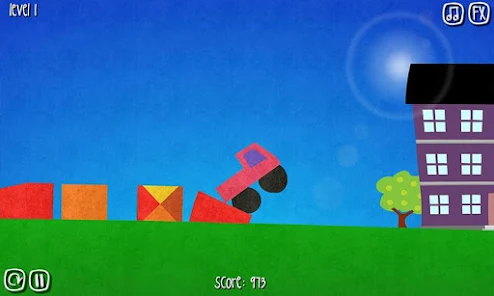
Watching Jelly Truck in motion for the first time is genuinely surprising — the chassis wobbles like a half-set dessert, the wheels compress on landing, and the whole vehicle stretches around corners in ways that defy every expectation your brain has built up from normal driving games. Created by Yev Logvenov, this soft-body physics experiment turns each course into a negotiation between momentum and squish. Too much throttle and the truck oscillates wildly, threatening to flip; too little and it collapses into dips that the soft body can’t recover from without a gentle nudge. The appeal is entirely tactile, communicated through a screen.

Geometry That Only Makes Sense in Gelatin
The courses in Jelly Truck are designed around a single question: how would this obstacle change if your vehicle had no rigid structure? Steep ramps that a normal car would bounce off become slow, absorptive climbs. Tight passages that would crush a steel chassis get squeezed through as the jelly body deforms just enough to pass, then springs back. This deformation-recovery loop is the core mechanic — every level is essentially a sequence of challenges where you need to predict how the blob will compress and where it will expand on the other side.
Small Sessions, Enormous Satisfaction
What Jelly Truck does brilliantly is compress its best moments into a format that fits any attention span. Each level is short enough to restart without frustration, but the physics simulation is complex enough that no two runs feel identical — a slightly different entry angle changes everything. When you finally thread a tricky gap without the truck tipping, the wobbling recovery of the jelly body looks almost like relief. That tiny anthropomorphic moment, a vehicle visibly collecting itself after a near-disaster, is the kind of detail that turns a physics tech demo into something genuinely charming.
Comments 0