











Two Elements, One Exit
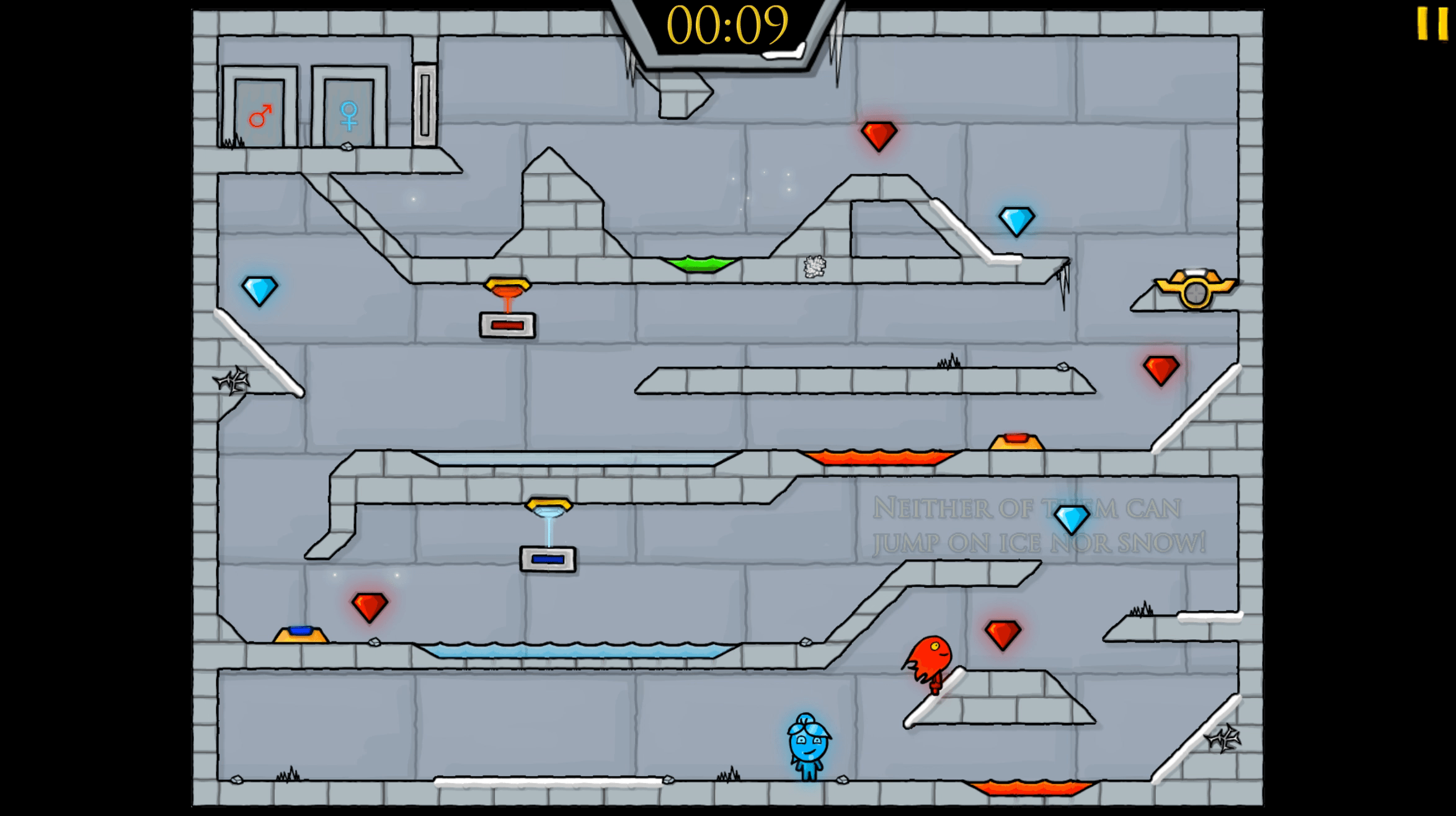
The elemental rule at the heart of Fireboy and Watergirl is elegantly simple: Fireboy thrives in lava but dissolves in water, Watergirl sails through pools but can't survive flames, and neither can touch the toxic green goo that lines the floors of deeper temple rooms. This constraint transforms every level into a spatial negotiation between two characters who must constantly depend on each other — one pulls a lever to lift a platform the other is standing on, or holds a pressure plate while the partner crosses a gap that would otherwise close before they reach it.

Splitting the Screen, Splitting the Work
What makes the game genuinely interesting rather than just charming is the asymmetry of each character's path through a level. Fireboy's route and Watergirl's route rarely overlap for long, which means a single player controlling both must maintain awareness of two separate spatial problems simultaneously — a genuine cognitive challenge that becomes meditative with practice. Playing with a partner adds communication as a third layer, since one person can see what the other cannot, and conveying timing information quickly becomes as important as executing the movement itself.
Gems, Gems, and the Optional Challenge
Reaching the exit doors completes a level, but collecting all the coloured gems scattered throughout is where the real puzzles hide. Red gems belong exclusively to Fireboy, blue gems to Watergirl, and the yellow ones in between require carefully coordinating pickup timing without contaminating either character's path. Many gem locations sit just off the direct route to the exit, forcing players to make deliberate detours. Clearing a temple with a perfect gem collection transforms a straightforward run into a precisely choreographed performance of elemental cooperation.
Comments 0