











Chaos, Physics, and the Art of Qualifying
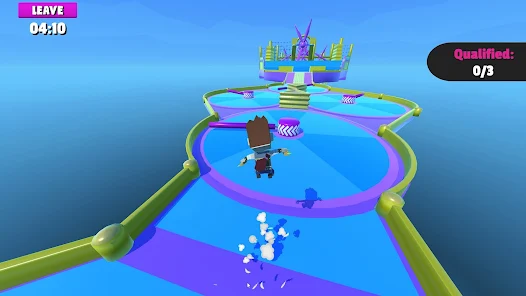
Each round of Fall Boys drops a crowd of wobbly contestants onto an obstacle course built to humble anyone who sprints blindly. Rotating hammers, tilting platforms, and sudden wall panels all operate on timed cycles — learn those rhythms and you move through the chaos efficiently. The physics engine rewards players who commit fully: half-hearted jumps clip edges and send you tumbling, while confident leaps arc cleanly past every hazard. Survive enough rounds and you reach the final stage, where one winner claims the crown.

Reading the Course Like a Veteran
Experienced players treat each obstacle layout as a pattern problem rather than a reflex test. Spinning beams have fixed rotation speeds, conveyor belts accelerate in predictable bursts, and crowd funnels always create the same bottleneck near the inner lane — so positioning early is far more effective than fighting for space at the last second. Watch the first cycle without committing, identify the safe gap, then thread through while everyone else collides. One clean read per obstacle is worth a dozen lucky scrambles.
When Diving Saves the Run
The dive mechanic is Fall Boys' most versatile tool and most misused one. Tapping dive too early stalls your forward momentum and leaves you flat on the floor; holding it at the perfect instant converts a near-miss into a dramatic across-the-line qualify. Use it to extend a jump over wide gaps, to slide under low-clearance crushers, or to push through a jostling crowd right before the finish gate closes. A single well-timed dive in the final metres has rescued countless runs that looked completely lost.
Comments 0